SLR FOUNDATIONS · PRE-HANDS-ON LEARNING
Anatomy of an SLR Article
Understand what belongs in each manuscript section
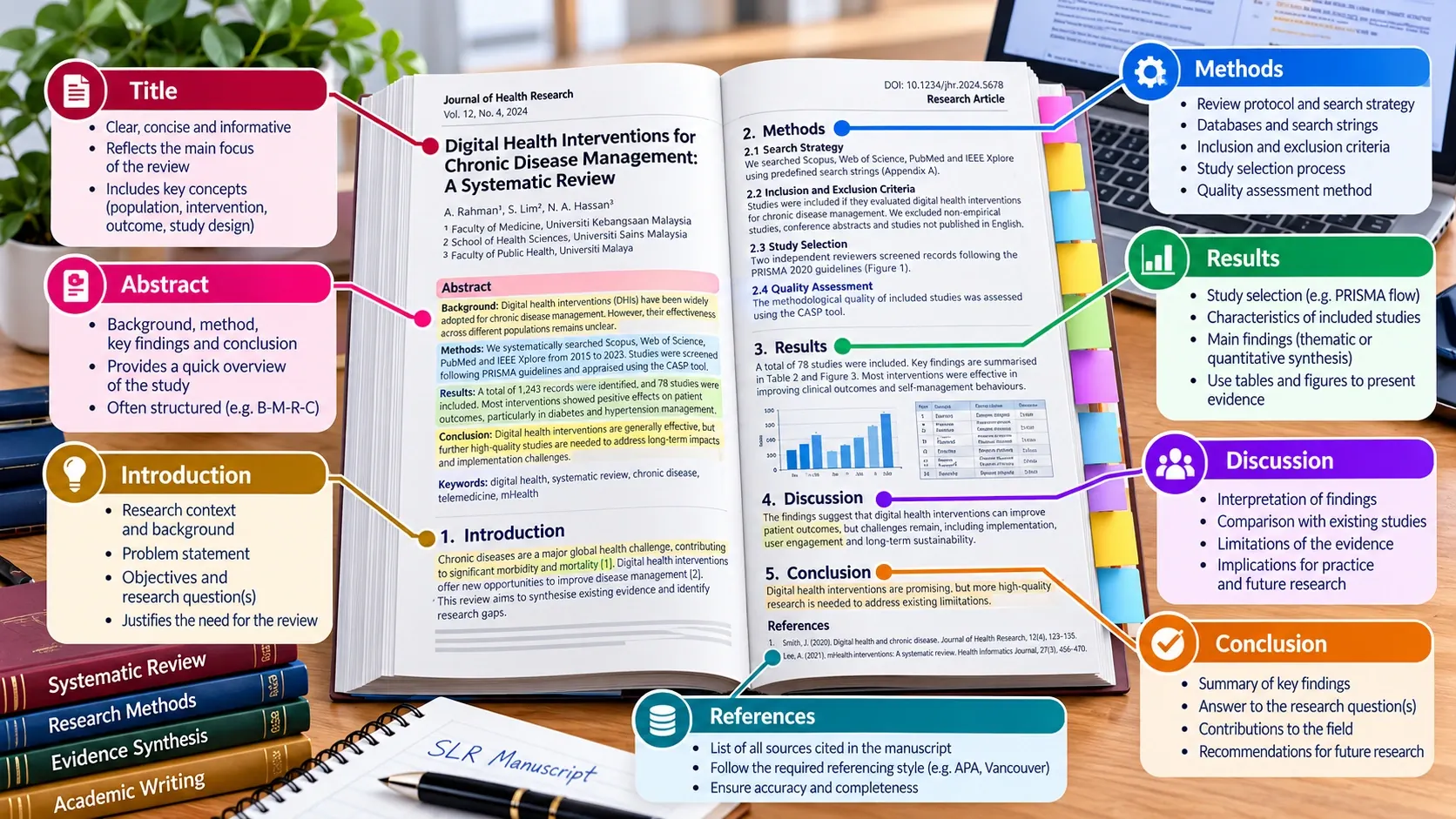
Manuscript sections
| Section | What to report |
|---|---|
| Title & Abstract | Review focus, objectives, methods, key findings and conclusion. |
| Introduction | Problem context, rationale, gap and review objectives. |
| Methods | Protocol, RQs, databases, full search strategies, dates, eligibility, selection, appraisal and synthesis approach. |
| Results | Search and screening counts, study characteristics and evidence relevant to each RQ. |
| Discussion | Interpretation, contribution, implications, limitations and future directions. |
| Conclusion | Concise answers and justified implications. |
| References & Supplements | Cited sources, full search strings, forms, extracted data and reporting checklists as appropriate. |
Follow the target journal's author instructions; no single manuscript template fits every discipline or review type.
Worked example
Topic: Explainable AI for IoT intrusion detection.
RQ: What XAI techniques are used, and how are effectiveness and interpretability evaluated?
Methods: State databases, exact searches, dates, screening decisions and synthesis method.
Results: Summarise included studies by XAI approach, dataset and evaluation criteria; do not invent study counts or citations.